
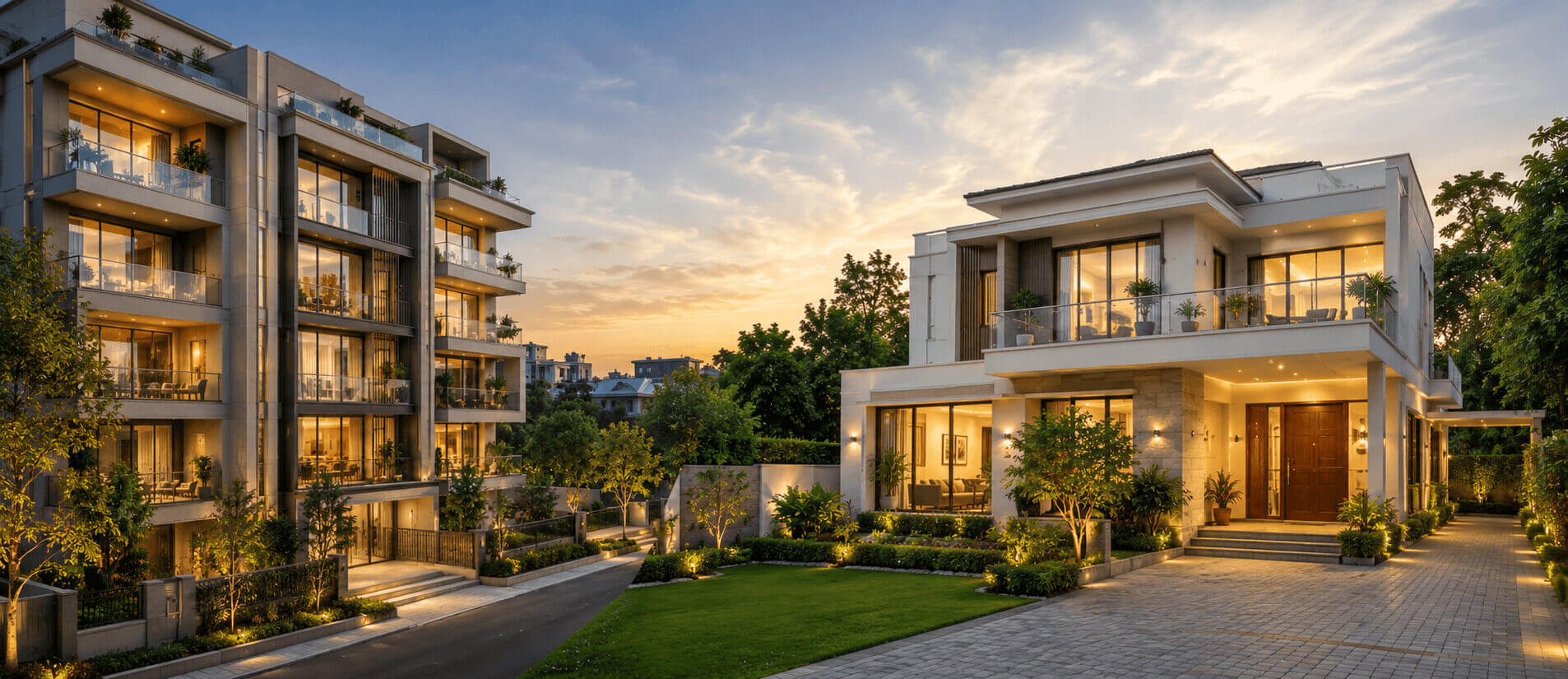
South Delhi has long appealed to affluent homebuyers who look beyond square footage. Address, privacy, architecture, convenience and the quality of ownership all shape the decision.
This makes the choice between luxury apartments vs independent homes particularly relevant. Independent homes offer land ownership and autonomy, while contemporary luxury apartments bring together expansive residences, curated amenities, security and professional management.
For an HNI, the real question is not which format offers more space, but which delivers the right balance of privacy, convenience, lifestyle, ownership responsibility and long-term value.
Luxury Apartments vs Independent Homes: At a Glance
| Factor | Luxury Apartments | Independent Homes |
|---|---|---|
| Privacy | High in low-density developments with controlled access | Very high within the individual property |
| Amenities | Integrated wellness, recreation and leisure facilities | Usually self-created or accessed externally |
| Security | Professional security and controlled entry | Primarily privately managed |
| Maintenance | Shared and professionally managed | Owner-managed |
| Community | Curated residential environment | Greater independence |
| Convenience | Strong, with managed services and amenities | Greater responsibility for upkeep |
| Location efficiency | Can offer substantial living space in established urban locations | Large plots can be difficult to source in premium areas |
| Best suited for | HNIs seeking contemporary luxury with convenience | Buyers prioritising land ownership and autonomy |
Verdict: Luxury apartments can offer a more integrated lifestyle for buyers who value design, amenities, security and professional management. Independent homes remain compelling for those who place land ownership, customisation and autonomy above convenience.
What Defines a Luxury Apartment in South Delhi?
At the premium end of the market, a luxury apartment is defined by more than finishes and floor area. The residence becomes part of a larger ecosystem designed around comfort, privacy and ease of living.
Depending on the development, this may include:
- Generously planned residences
- Private or controlled lift access
- Premium specifications and finishes
- Landscaped spaces
- Club, wellness and recreation facilities
- Dedicated security infrastructure
- Parking and visitor management
- Professionally maintained common areas
The advantage becomes particularly relevant in established urban markets where large land parcels are limited. A well-conceived luxury development can offer contemporary architecture and modern amenities without compromising on an established city address.
What Makes Independent Homes Attractive?
The appeal of an independent home lies in control. Owners have greater freedom over interiors, renovations, landscaping and the use of private outdoor areas, subject to applicable regulations.
For some HNIs, that autonomy is itself a form of luxury. The property offers a private domain rather than a residence within a shared development.
There is also a stronger connection to the underlying land. However, that ownership comes with responsibility. Structural upkeep, landscaping, security, repairs and domestic infrastructure remain the owner's concern.
Luxury Apartments or Independent Homes: What Should HNIs Consider?
1. Privacy and Personal Space
Independent homes naturally offer control over the entire property. Luxury apartments approach privacy differently, relying on low density, thoughtful planning, controlled access and, where provided, private lift arrangements.
For buyers who want privacy without taking on the responsibilities of a standalone property, the design of the development becomes an important consideration.
2. Amenities as Part of Everyday Living
An independent home allows owners to create their own lifestyle infrastructure, but doing so requires additional space, investment and management.
A premium apartment can integrate fitness, wellness, recreation, landscaped areas and social spaces into the residential environment. The distinction is less about the number of amenities and more about how seamlessly they fit into everyday life.
For modern HNIs, luxury increasingly means reducing friction, not simply increasing space.
3. Maintenance and Ownership Responsibility
The ownership experience changes significantly between the two formats.
Independent homeowners directly manage most property-related requirements. In a professionally managed apartment development, shared infrastructure and common areas are maintained through the project's management framework.
This can make ownership more predictable, particularly for buyers with demanding professional schedules or frequent travel.
4. Location and Urban Efficiency
In a mature South Delhi market, acquiring a substantial independent plot in a sought-after neighbourhood can be challenging. Luxury apartments offer another route to premium urban living by combining sizeable residences with contemporary planning on efficiently developed land.
For buyers, this makes the development's density, planning and quality of architecture as important as the address itself.
5. Investment and Long-Term Value
Neither format should automatically be considered the superior investment.
An independent home's value is influenced heavily by its land component, location, plot characteristics and redevelopment potential. A luxury apartment depends more on factors such as the developer, project quality, configuration, maintenance, location, demand and future competing supply.
Before committing, buyers should evaluate:
- Title and legal documentation
- RERA registration, where applicable
- Developer credentials and track record
- Construction and specification quality
- Location and connectivity
- Total acquisition and ownership costs
- Resale and rental potential
- Future development considerations
Project-specific claims should always be verified against statutory and official documentation rather than relying solely on marketing material.
Why Luxury Apartments Appeal to Modern HNIs
The strongest argument for luxury apartments is not that they replace independent homes. They offer a different ownership proposition.
A thoughtfully designed development can bring privacy, architecture, security, amenities and professional management together within one address. This creates an ownership experience where the residence is supported by an environment rather than operating as a standalone asset.
KREEVA's approach to premium residential development reflects this shift towards design-led, contemporary homes within established urban markets. Its portfolio positions luxury around the quality of the residence as well as the broader living experience.
For buyers exploring apartments in South Delhi, the evaluation should therefore extend beyond the façade or amenity list. Residential density, floor plans, privacy, specifications, construction quality, developer credentials, project documentation and long-term maintainability all deserve close attention.
Conclusion
The choice between luxury apartments vs independent homes ultimately depends on what the buyer considers essential.
Independent homes remain the stronger proposition for those who prioritise land ownership, autonomy and extensive customisation. Luxury apartments can be better suited to HNIs who value contemporary design, integrated amenities, security and a professionally managed ownership experience.
The smartest comparison is therefore not simply between two property types. It is between two different ways of living and owning. For premium buyers, the right choice is the one that delivers the desired combination of space, privacy, convenience, design and long-term ownership quality.