
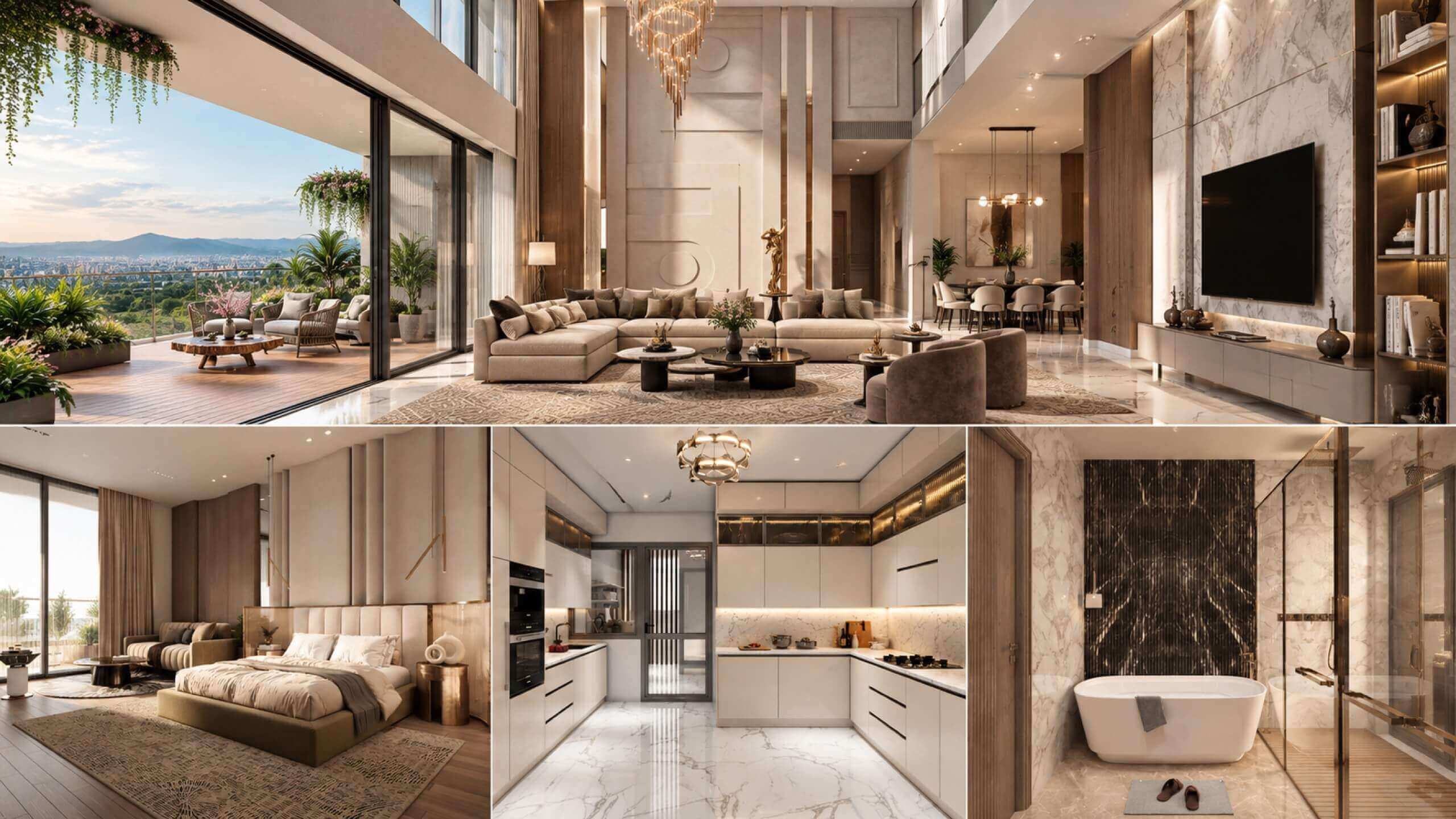
South Delhi doesn't need an introduction. Its name carries decades of prestige, from the tree-lined avenues of Greater Kailash to the diplomatic calm of Vasant Vihar.
But for today's homebuyer, often a high-net-worth individual (HNI) comparing options across the city, a legacy address is no longer the whole story. The sharper question is: what actually separates an ordinary flat from a genuine ultra-luxury residence?
It's a question we think about constantly at KREEVA, because it shapes every decision we make from the plot we choose to the number of homes we build on it. This guide looks at what defines luxury apartments in South Delhi in 2026, using verified market context, and how those principles take shape in Swaranaya, our address in New Friends Colony.
What "Luxury" Used to Mean and What It Means Now
A decade ago, luxury in Delhi real estate was largely about scale: bigger floor plates, taller ceilings and more marble. Those elements still matter, but they no longer define the category on their own.
Today's buyers are increasingly looking for homes that work around their routines, privacy needs, family structures and long-term plans. At Swaranaya, this shift is reflected in decisions ranging from the number of residences to the way individual layouts are planned.
An Address That Goes Beyond a Pin Code
Location has always mattered in real estate. In South Delhi, its value is closely tied to the maturity of the neighbourhood.
Schools, hospitals, markets and green spaces have developed here over generations. That established ecosystem is difficult to recreate through a new project, particularly when developable land is limited.
The Colonies That Define South Delhi's Luxury Belt
South Delhi's 40-plus established colonies are not interchangeable. Vasant Vihar and Golf Links sit at the upper end of the market, while Greater Kailash and New Friends Colony offer comparatively different entry points within the same established urban ecosystem.
For a closer, street-by-street look at these neighbourhoods, our guide to posh areas in South Delhi explores the differences, while what makes South Delhi a prime location for luxury homes examines the infrastructure and connectivity supporting the market.
Why Scarcity Matters
South Delhi's established colonies operate within a planned urban framework, where new supply is constrained by the availability of existing plots and redevelopment opportunities. Unlike newer micro-markets, there is comparatively little scope to create large volumes of fresh residential land.
For buyers, that makes the underlying land supply an important consideration alongside the apartment itself. Swaranaya follows this redevelopment-led model in New Friends Colony, placing the residence within an established neighbourhood rather than a newly emerging micro-market.
What Actually Defines an Ultra-Luxury Residence Today
The definition of ultra-luxury varies between buyers, but several characteristics consistently influence how a residence is experienced: space planning, architectural restraint, useful amenities, privacy and controlled density.
Space Planned With Intention
A larger floor plate does not automatically create a better home. The relationship between living, dining and private areas determines whether the space feels effortless or fragmented.
Natural light, ceiling height and circulation also influence the experience of scale. At Swaranaya, wraparound balconies extend usable outdoor space, while selected residences are oriented towards views of the Lotus Temple rather than directly towards neighbouring walls.
Design That Doesn't Chase Trends
Luxury interiors are increasingly moving away from visual excess. Considered materials, restrained detailing and deliberate lighting can create a more enduring character than design choices built around short-lived trends.
The same approach informs Swaranaya's architecture and common areas, where the emphasis is on a composed aesthetic designed to remain relevant beyond the launch period.
Amenities Built Around Daily Routine
An amenity adds value when it supports everyday life rather than simply expanding a brochure's checklist.
Swaranaya's approximately 1.5 lakh sq. ft. clubhouse includes a fully equipped gymnasium and sits within 1.5 acres of landscaped greens. The emphasis is on spaces residents can incorporate into regular routines, from exercise to outdoor downtime.
Privacy Built Into the Architecture
Privacy in an ultra-luxury residence extends beyond security systems. It also depends on how residents enter and move through the building.
At Swaranaya, each residence has its own private lift lobby, while grand atrium-height lobbies create a more spacious arrival experience. These features address privacy and arrival at the building level rather than treating them as afterthoughts.
Exclusivity Through Controlled Density
Another defining consideration is how many households share the development. Swaranaya is limited to 114 residences, creating a lower-density environment relative to the scale of the project.
For buyers who place a premium on fewer neighbours and a more private residential setting, the total number of residences can therefore be as relevant as the apartment's internal specifications.
If you're comparing this model with a plot-and-build option, our comparison of luxury apartments vs independent homes looks at differences in maintenance, security and long-term ownership considerations.
Choosing the Right Configuration: 3 BHK or 4 BHK
Configuration is ultimately a question of how a household intends to use the home.
- 3 BHK residences can suit smaller families or buyers seeking a more manageable footprint without compromising on location or amenities. See our guide to 3 BHK flats in South Delhi.
- 4 BHK residences offer additional flexibility for larger households, multi-generational living or dedicated spaces such as a study, home office or entertainment room. Our guide to 4 BHK flats in South Delhi explores these considerations further.
Neither configuration is inherently more luxurious. The relevant question is whether the layout matches the household's actual requirements, both today and over the longer term.
Luxury Living in South Delhi: The Everyday Reality
The experience of luxury is often shaped by details that do not appear on a specification sheet: walking to a neighbourhood market, living among mature trees or having established schools and healthcare facilities close to home.
Connectivity is another practical consideration. Swaranaya is positioned along the Mathura Road corridor, near the Modi Mill flyover and Magenta Line metro, with access towards Nehru Place and Noida. These connections can influence the convenience of everyday commuting as much as the address itself.
Our companion piece on luxury living in South Delhi looks more closely at the neighbourhood experience beyond the apartment.
What HNIs Should Verify Before Signing
A premium price does not remove the need for property due diligence. Before finalising a purchase, buyers should verify:
- RERA registration and applicable project approvals.
- Land title and chain of ownership.
- The real estate developer's track record and delivery history.
- Actual carpet area against the advertised super built-up area.
- Maintenance structure and the society formation process after possession.
- Historical resale activity for comparable properties in the same micro-market.
Key Takeaways
- Ultra-luxury is increasingly defined by considered design, privacy, usability and controlled density rather than visible excess alone.
- An established South Delhi location brings access to mature social infrastructure and limited land supply.
- Floor-plan configuration should reflect household requirements rather than being treated as a proxy for luxury.
- Amenities matter most when they support everyday routines rather than simply adding to a specification list.
- RERA compliance, title clarity, developer credentials, area calculations and resale considerations should be verified before purchase.
For buyers evaluating a luxury apartment in South Delhi, the distinction between genuine luxury and surface-level marketing ultimately comes down to how the residence performs beyond the brochure — in its planning, privacy, neighbourhood and everyday usability.