
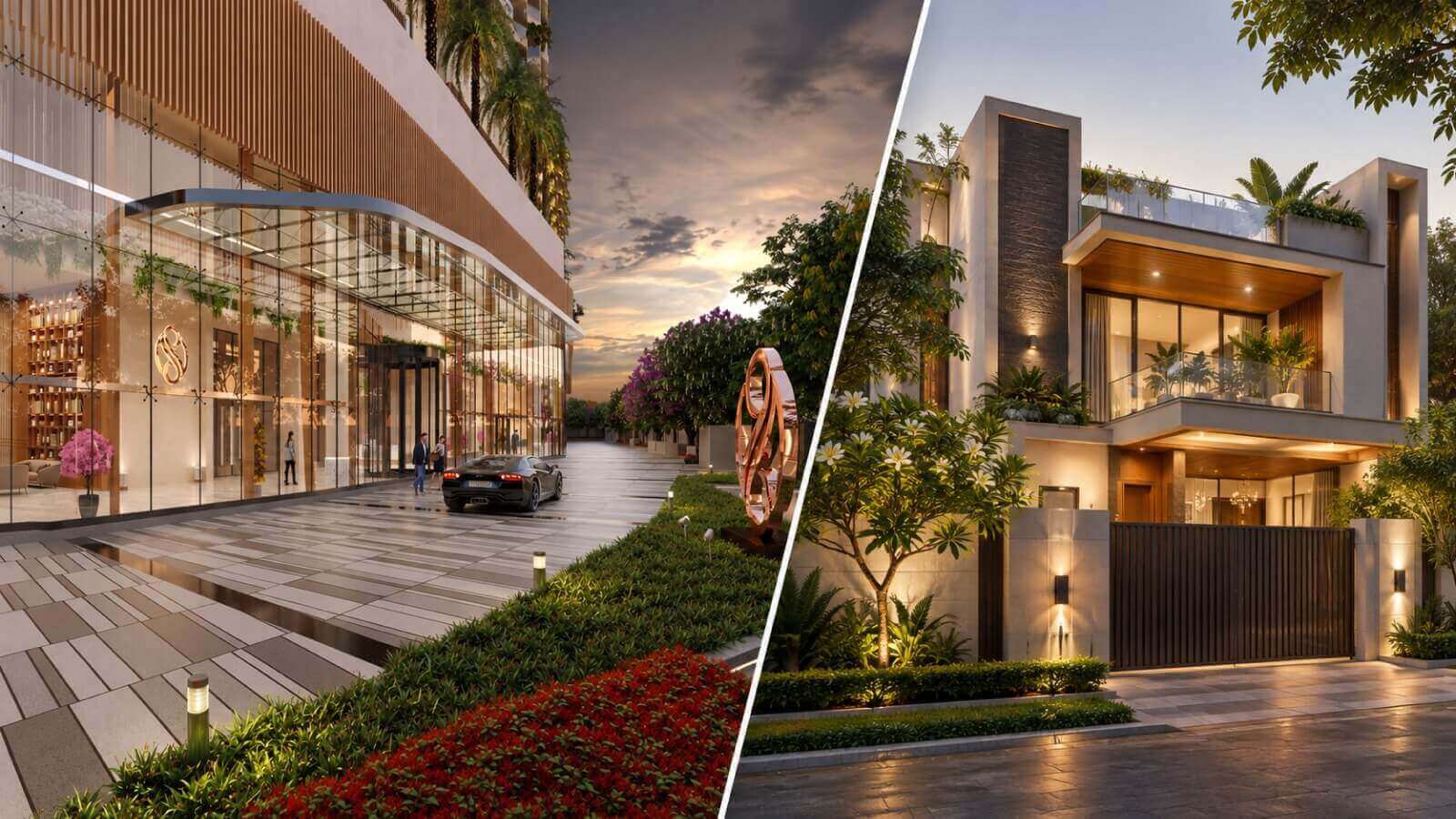
South Delhi combines established neighbourhoods, limited land supply and premium residential addresses. For high-net-worth buyers, the choice is often between a managed luxury apartment project such as Swaranaya and an independent home or builder floor.
Both formats offer privacy, space and access to established neighbourhoods, but they differ in amenities, management, land ownership, regulatory structure and day-to-day convenience. Understanding these differences can help buyers decide which format aligns with their priorities.
What are Independent Homes in South Delhi?
In South Delhi, the term independent homes commonly refers to builder floors or independent floors. A developer typically redevelops a residential plot into a low-rise building, often with stilt parking and multiple residential floors. Each buyer owns a floor along with a proportionate undivided share of the underlying land.
The main attraction is a private, low-rise living environment. Residents generally have fewer neighbours and greater control over their immediate residential setting. 3 BHK and 4 BHK flats are commonly available in this format, although sizes vary according to the plot and building plan.
What is Swaranaya?
Swaranaya is an ultra-luxury residential project by KREEVA in New Friends Colony, developed by a real estate developer backed by the Kanodia Group. The project offers 3, 4 and 5 BHK residences of approximately 3,500 to 5,500 sq ft within a low-density residential development.
Unlike an independent floor, Swaranaya is designed as a managed residential community with shared amenities and centralised services. This creates a different ownership and lifestyle experience.
Swaranaya vs Independent Homes: Key Differences
| Factor | Swaranaya | Independent Homes |
|---|---|---|
| Format | Managed luxury residential community | Individual floor in a low-rise building |
| Typical size | 3, 4 and 5 BHK, approximately 3,500-5,500 sq ft | Varies according to plot and floor plan |
| Security | Centralised security | Usually managed at building level |
| Amenities | Clubhouse, pool, gym, jogging track and shared spaces | Limited by plot size and building design |
| Maintenance | Professionally managed | Shared between floor owners |
| Land ownership | Proportionate share in a larger development | Proportionate share in the individual plot |
| Regulation | RERA-registered project | RERA applicability varies by project and plot |
1. Lifestyle and Amenities
The biggest lifestyle difference is access to shared facilities. A builder floor primarily provides a private residence, while a managed development adds common spaces and services around it.
Swaranaya lists amenities such as a clubhouse, swimming pool, jogging track and open recreation areas. It also features a double-height lobby, VRV air conditioning and round-the-clock security. Independent floors generally have fewer shared facilities because their amenities are constrained by the size and configuration of the underlying plot.
For buyers who regularly entertain guests or want wellness and recreational facilities within the development, this distinction can be important.
2. Space, Layout and Privacy
Independent floors offer a low-density setting with relatively few neighbours. A private entrance and the absence of a large shared lobby can appeal to buyers who prefer the character of a standalone residence.
Swaranaya approaches privacy through larger residences and controlled density. Its larger floor plates can accommodate separate family, guest and service areas, giving residents more flexibility in how the home is organised.
The choice therefore comes down to the type of privacy a buyer values: the independence of a low-rise floor or the scale and planning of a managed luxury residence.
3. Legal Due Diligence and RERA
Regulatory requirements can differ significantly between the two formats. Delhi RERA's April 2022 public notice states that projects on land exceeding 500 square metres require registration, subject to the applicable provisions. Smaller single-plot developments may fall outside RERA registration depending on their circumstances.
This makes document verification particularly important when purchasing an independent floor. Buyers should examine:
- The complete ownership chain of the plot.
- The sanctioned building plan and completion documentation.
- The proportionate undivided land share.
- Any collaboration or development agreement between the landowner and builder.
- Parking rights and their treatment in the sale documents.
A RERA-registered project provides buyers with a public regulatory record covering registration and prescribed project disclosures. However, RERA registration does not replace independent legal due diligence.
4. Land Ownership and Long-Term Considerations
An independent floor can provide a relatively larger proportionate share of a smaller residential plot. For buyers who place a high value on land ownership, this can be an important consideration.
The trade-off is collective ownership. Future redevelopment, structural decisions or major changes to a low-rise property may require coordination among multiple owners.
In a managed development, each residence generally represents a smaller share of the overall land parcel, but the ownership structure is designed around a larger, professionally managed community. Buyers should therefore compare the land component with the lifestyle and management benefits rather than treating either format as automatically superior.
Property appreciation also depends on factors such as location, demand, supply, property condition and broader market cycles. Neither format guarantees a particular return.
5. Convenience and Everyday Management
New Friends Colony is an established South Delhi neighbourhood with access to major roads and public transport. Swaranaya's location provides connectivity towards the DND Flyway, Ashram Chowk and Greater Kailash, while Sukhdev Vihar and Ashram metro stations serve the wider area.
Independent floors in the same neighbourhood benefit from similar location advantages. The difference is primarily at the property level.
In a managed development, common-area maintenance, security and shared facilities are handled through a central management structure. In an independent building, owners typically share responsibility for common areas, maintenance and building-level decisions.
Parking should also be verified before purchase. Buyers should confirm the designated parking arrangement and ensure the relevant rights are clearly documented in the sale agreement and other applicable records.
Who Should Consider Swaranaya?
Swaranaya may suit buyers who:
- Prefer a managed luxury residential environment.
- Want larger residences with shared amenities.
- Value professionally maintained common areas and security.
- Prefer a RERA-registered project with public disclosures.
- Want a low-maintenance home, particularly if they travel frequently.
Who Should Consider an Independent Home?
An independent home may suit buyers who:
- Prefer a low-rise residential setting.
- Place greater importance on their proportionate land share.
- Prefer a more independent ownership structure at the building level.
- Are prepared to undertake detailed legal, structural and title due diligence.
The Final Verdict
The choice between Swaranaya and an independent home in South Delhi depends on how a buyer prioritises space, privacy, amenities, land ownership, management and regulatory documentation.
Swaranaya combines large-format residences with shared amenities and professional management within a planned residential community. Independent homes offer a different proposition, centred on low-rise living, private access and a proportionate share of the underlying plot.
For buyers comparing flats in South Delhi, the practical approach is to evaluate the title documents, RERA status where applicable, floor plans, parking rights, maintenance structure and total ownership costs before making a decision.
To explore residences at Swaranaya, contact KREEVA at info@kreeva.in or +91 7838212212.